32.6% of recent immigrants with post-secondary qualifications in Canada reported being overqualified for jobs. 25.6%of recent immigrants with post-secondary qualifications worked in jobs typically requiring a high school diploma or less. 43.2% of the foreign-born U.S. labour force aged 25+ hold a bachelor’s degree or higher. 20% of college-educated immigrants in the U.S. are working in lower-skilled jobs. 29.5% of the Canadian population could converse in a non-official language. 3.1 millionCanadian households, representing 21% of households, are multilingual. 22% of people aged 5+ in the U.S. speak a language other than English at home. 101,541 new registrations were recorded in Canadian apprenticeship programs. 100,000 more youth apprentices were served in the U.S. 41% of apprentices served in the U.S. were aged 24 or younger.
Your next best-fit student may already have a degree.
Statistics Canada found that nearly one-quarter of recent immigrants with post-secondary qualifications were working in roles that typically require a high school diploma or less.
In the U.S., the numbers are similar, with the Bureau of Labor Statistics noting that 20% of college-educated immigrants work in lower-skilled jobs.
This is where higher education has an opportunity.
These prospects are missing a pathway that connects their existing skills and credentials to local employers, professional expectations, and career opportunities.
This is especially relevant for: Bridging programs Graduate certificates Professional master’s programs Continuing education Career-focused and skills-based pathways Your next move: Make the transition visible.
Stronger program messaging should clearly explain:
➡️ Who the pathway is designed for ➡️ How previous education or experience may apply ➡️ What specific gap the program helps address ➡️ What local knowledge, skills, or credentials students can gain ➡️ What career transition the program is intended to support ➡️ What advising, networking, and experiential learning are available
The goal is to help learners understand how the program can build on what they’ve already achieved.
A quick test: Could a prospective learner understand, within 30 seconds, what your program helps them move from and what it helps them move toward?
Let’s work together to build trust, reduce program uncertainty, and support better-fit enrolment.
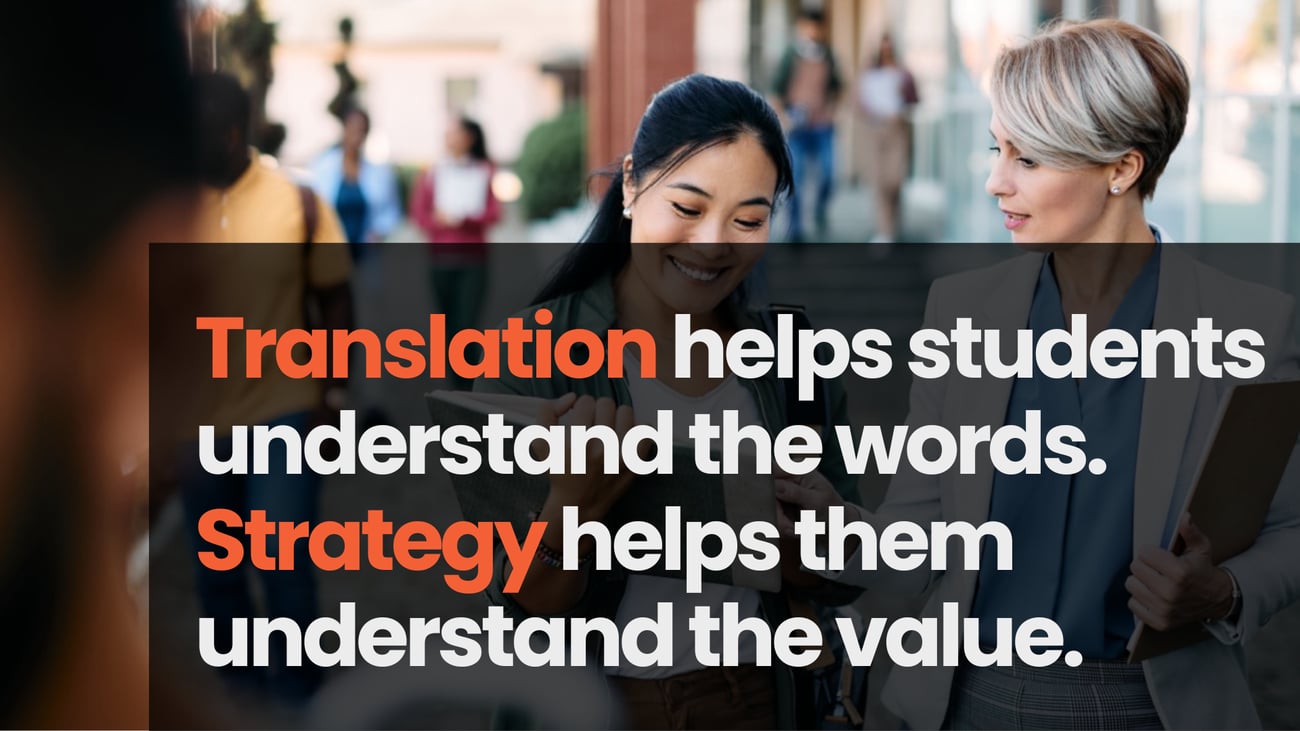
Translation helps students understand the words. Strategy helps them understand the value.
Canada is linguistically diverse. Approximately 6.6 millionpeople can converse in English and French, 10.7 million can converse in a non-official language, and more than one in five households are multilingual.
In the U.S., 22% of people aged five and older speak a language other than English at home.
For higher education, this is an opportunity to build value and trust by providing more than just translation. Here’s how:
Start with the audience, not the language.
Before developing bilingual or multilingual recruitment content, institutions should ask:
➡️ Who are we trying to reach? ➡️ Which language do they prefer when researching an important decision? ➡️ What concerns are most relevant to this audience? ➡️ Which outcomes and proof points build confidence? ➡️ Which channels do they use to discover and compare programs? ➡️ Does the experience remain clear after the first click?
A translated ad may attract attention, but the complete journey should also help the learner:
Understand the program Review admissions requirements Compare costs and timelines Access relevant student stories Complete the next step Receive helpful follow-up
The goal is to build the right experience, in the right language, for the audiences an institution is committed to serving.
Degrees aren’t the only pathway gaining momentum.
New registrations in Canadian apprenticeship programs reached a record 101,541 in 2024, increasing 5.9% in one year.
The shift is visible in the U.S., too.
The number of youth apprentices served increased by approximately 100,000. In education alone, nearly 13,000 registered apprentices were served in 2024, representing 425% growth over five years.
This is a reminder that learners are comparing more education pathways, formats, timelines, and definitions of value than ever. So here’s what you need to know.
Every pathway needs to answer five questions:
Why this credential?
Why this format?
Why this timeline?
Why this institution?
Why is this the right next step?
The answer should reflect what makes each pathway genuinely valuable.
➡️ Degree programs can emphasize depth, intellectual development, professional mobility, networks, and long-term possibilities. ➡️ Certificates & microcredentials can emphasize specialization, accessibility, speed, and stackability. ➡️ Apprenticeships & trade programs can emphasize applied learning, mentorship, paid experience, and occupational alignment. ➡️ Professional & continuing education can show how existing knowledge connects to advancement, specialization, or a new professional context.
Clear differentiation helps students confidently identify the pathway that fits their goals.
Book a meeting with Noetic Marketerfor stronger program positioning and a full-funnel enrolment strategy that turns learner expectations into clear, mission-aligned opportunities.
Measuring return on investment in higher education marketing requires moving beyond vanity metrics like impressions. Learn how to implement full-funnel tracking, use complex attribution models, and focus on core metrics such as cost per lead and cost per enrolled student. Discover how to connect your digital marketing spend directly to real student enrolment outcomes.
Paid advertising helps higher education institutions reach prospective students at key moments in their decision journey. This blog explains how you can use full-funnel paid media strategies, audience targeting, remarketing, and landing page optimization to drive more qualified leads and student applications.
Choosing the right higher education marketing agency requires more than checking portfolios. It demands a strategy-first partner that understands the student recruitment funnel, navigates Canadian market shifts, and connects digital marketing campaigns to measurable enrolment outcomes.